
The CBD market has grown into a multi-billion dollar industry, and walking through it without a roadmap can feel overwhelming. Between CBD oil benefits, hemp-derived CBD products, and dozens of formats on store shelves, most beginners have no idea where to start. This guide cuts through the noise — helping you understand what matters, what to look for, and how to find the best CBD products for beginners and experienced users alike.
Whether you’re exploring cannabidiol product selection for the first time or trying to upgrade your current CBD wellness routine, the most important thing to understand is this: there is no one-size-fits-all answer. The right product depends on your health goals, lifestyle, and body chemistry. Let’s break it all down.
Step 1: Know What You Want CBD to Do
Start with your goal. CBD is used for a wide range of purposes — from CBD for anxiety relief and CBD for sleep support, to CBD for inflammation and chronic pain management. The condition or concern you want to address will directly influence which product format and potency is best for you.
Here are the most common use cases and the product types that tend to work well for each:
- CBD for anxiety relief: Fast-absorbing formats like sublingual tinctures are ideal. They enter the bloodstream within 15–30 minutes.
- CBD for sleep support: Capsules or oils taken 45–60 minutes before bed allow time for the compound to settle in.
- CBD for chronic pain: A combination of oral CBD for systemic effects and CBD topicals for targeted, localized relief often works well.
- CBD for inflammation: Full spectrum or broad spectrum oils are popular choices here, thanks to the anti-inflammatory properties of multiple hemp compounds.
- Daily wellness: CBD gummies vs oil is the classic debate — gummies win on convenience, oils on dosing flexibility.
Step 2: Understand the Three Types of CBD
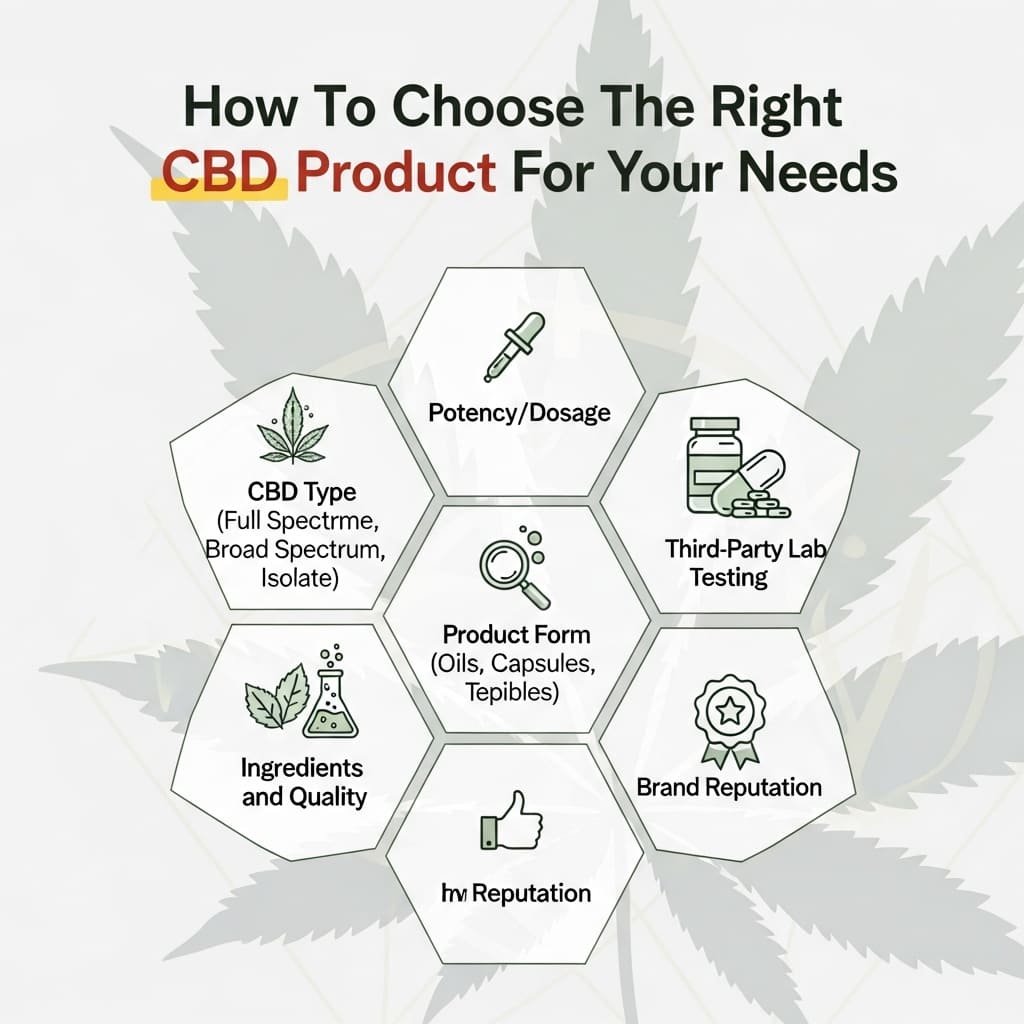
Before you buy anything, you need to understand the core difference between full spectrum vs broad spectrum CBD, and CBD isolate. This is the foundation of any smart cannabidiol product selection.
Full Spectrum CBD: Contains all naturally occurring cannabinoids and terpenes from the hemp plant, including trace amounts of THC (up to 0.3%). The entourage effect cannabinoids create together may enhance the overall benefit — this is why many users find full spectrum the most effective option.
Broad Spectrum CBD: Similar to full spectrum, but with the THC removed through additional processing. You still get the entourage effect from the remaining hemp compounds — minus the THC. Great for those who want CBD product types comparison without any psychoactive risk.
CBD Isolate: The purest form of cannabidiol — 99%+ pure, with no other plant compounds. It has zero flavor, zero THC, and is usually the most affordable. However, isolate vs full spectrum comparisons consistently show that isolate may be less effective for certain conditions.
Quick tip: If you’re new to CBD, broad spectrum is the safest starting point — you get multi-compound benefits without THC exposure.
Step 3: Choose the Right Product Format
CBD absorption methods vary significantly by format. Understanding CBD bioavailability — how much CBD actually reaches your bloodstream — helps you choose more effectively.
CBD Tinctures vs Capsules: Tinctures held under the tongue (sublingual) absorb in 15–30 minutes with high bioavailability. Capsules pass through the digestive system, taking 45–90 minutes but providing steady, long-lasting effects.
CBD Gummies vs Oil: Gummies are pre-dosed, discreet, and easy to use daily — perfect for a CBD wellness routine. Oils offer more flexible dosing but require a dropper and some patience.
CBD Topicals vs Oral CBD: Topicals (creams, balms, roll-ons) never enter the bloodstream — they work locally on muscles, joints, and skin. Oral CBD provides full-body, systemic effects. For localized chronic pain or inflammation, topicals are often used alongside oral CBD serving size recommendations for best results.
CBD Vapes: Offer the fastest onset (within minutes) due to direct lung absorption — the highest CBD bioavailability of any format. However, they carry respiratory considerations and aren’t suitable for everyone.
Step 4: Nail Your CBD Dosage
There is no universal CBD dosage guide that works for everyone. Factors like body weight, metabolism, the severity of your condition, and hemp extract concentration all influence how much you need.
A smart approach is to follow a standard CBD serving size recommendation: start with 10–15mg per day, hold that dose for 7–10 days, then increase by 5mg increments if needed. CBD potency levels also vary widely across products — a 500mg bottle and a 3000mg bottle of the same size require very different serving sizes.
Important: If you are taking any prescription medications, consult your doctor before using CBD. Some drugs — especially those with a grapefruit warning — can interact with cannabidiol.
Step 5: How to Read CBD Product Labels
One of the most overlooked skills in CBD shopping is knowing how to decode CBD product labels explained clearly. Here’s what to look for:
- Total CBD content: Should be listed in milligrams (mg), not just as a percentage.
- Type of CBD: The label should clearly state full spectrum, broad spectrum, or isolate.
- Hemp extract concentration: Tells you how potent each serving is.
- Ingredients list: Organic CBD oil products will typically list organic hemp extract, a carrier oil (MCT or hemp seed oil), and natural flavorings only.
- Serving size: Always check suggested CBD serving size recommendations before calculating your dose.
Step 6: Prioritize CBD Quality Indicators
The CBD market is largely unregulated, which makes CBD quality indicators essential to understand. Cheap products often cut corners in ways you can’t see — but you can feel.
Here’s what separates reputable CBD brands from the rest:
- Third-party lab testing: Always look for a COA (Certificate of Analysis) from an independent lab. This document verifies potency and confirms the product is free of pesticides, heavy metals, and residual solvents. No COA = walk away.
- CO2 extraction method: The CBD extraction methods matter. CO2 extraction is the gold standard — clean, solvent-free, and highly efficient. Cheaper ethanol methods can leave behind residual chemicals.
- Organic, hemp-derived CBD: Hemp is a bioaccumulator — it absorbs what’s in the soil. Organic CBD oil from organically grown hemp reduces contaminant risk significantly.
- Transparent brand practices: Reputable CBD brands publish their lab results, list sourcing information, and offer clear return policies.
- THC-free CBD products: If you’re subject to drug testing, verify that the product is certified THC-free, not just “broad spectrum.”
Building a CBD Wellness Routine That Lasts
Once you’ve found a product that works, consistency is everything. CBD works best when used regularly — many users report that it takes 2–4 weeks of consistent use before they feel the full benefits.
Here are a few tips to build a sustainable CBD wellness routine:
- Take CBD at the same time each day to build a habit.
- Keep a simple log of dose, time, and how you feel.
- Reassess every two weeks and adjust your CBD dosage guide accordingly.
- Pair CBD with other healthy habits — good sleep, hydration, and movement amplify its effects.
Remember: CBD is a wellness tool, not a cure. It works best as part of a broader lifestyle approach.
The Bottom Line
Choosing the right CBD product comes down to clarity: know your goal, understand the CBD product types comparison, pick the right absorption method, start low on dosage, and always buy from reputable CBD brands that offer third-party lab testing (COA). Whether you’re drawn to CBD tinctures vs capsules, CBD gummies vs oil, or CBD topicals vs oral CBD — there’s an option that fits your life.
Take your time, pay attention to how your body responds, and don’t be afraid to try a different format if the first one doesn’t click. The right CBD product is out there — and now you have the tools to find it.
Frequently Asked Questions (FAQs)
Q1. What is the best CBD product for beginners?
For beginners, broad spectrum CBD oil or CBD gummies are the most recommended starting points. Both offer a balanced introduction to CBD without THC exposure. Start with a low dose (10mg) and increase gradually. Look for third-party lab tested CBD from reputable CBD brands to ensure quality.
Q2. What is the difference between full spectrum vs broad spectrum CBD?
Full spectrum CBD contains all hemp plant compounds including trace THC (up to 0.3%), allowing the entourage effect cannabinoids create together. Broad spectrum CBD has the THC removed but retains other beneficial cannabinoids and terpenes. CBD isolate is pure cannabidiol with no other compounds. For most users, broad spectrum hits the sweet spot.
Q3. How do I figure out the right CBD dosage for me?
There is no universal CBD dosage guide — it depends on body weight, metabolism, and the condition you’re addressing. A safe starting point is 10–15mg per day. Hold that dose for a week, observe effects, then increase by 5mg increments if needed. Always check the CBD serving size recommendations on your product label.
Q4. Is hemp-derived CBD legal?
Yes. Hemp-derived CBD products containing less than 0.3% THC are federally legal in the United States under the 2018 Farm Bill. However, state laws vary, so it’s worth checking your local regulations. Always buy from reputable CBD brands that provide a COA to confirm THC levels.
Q5. What does third-party lab testing (COA) mean?
A Certificate of Analysis (COA) is a document from an independent laboratory confirming a CBD product’s cannabinoid content, potency, and purity. It verifies that the product is free from pesticides, heavy metals, and residual solvents from CBD extraction methods. Any reputable CBD brand will make their COA publicly available on their website.
Q6. How long does it take for CBD to work?
CBD absorption methods vary by format. Sublingual tinctures work in 15–30 minutes. CBD capsules and gummies take 45–90 minutes due to digestion. CBD vapes act within minutes. CBD topicals work locally within 20–45 minutes. For ongoing conditions like anxiety or sleep support, consistent daily use over 2–4 weeks tends to show the best results.
Q7. Can CBD make you high?
No. CBD (cannabidiol) does not produce a psychoactive high. THC-free CBD products and broad spectrum formulas contain no detectable THC. Even full spectrum CBD, which contains trace amounts (under 0.3%), will not produce intoxication. CBD interacts with the endocannabinoid system differently than THC.
Q8. What should I look for on a CBD product label?
When reviewing CBD product labels, check for: total CBD content in milligrams, type of CBD (full spectrum, broad spectrum, or isolate), hemp extract concentration per serving, a complete ingredient list, and a QR code or link to the COA. Avoid products with vague labels that say only ‘hemp extract’ without specifying CBD content — this is a major red flag in CBD quality indicators.