
If you’ve shopped for CBD, you’ve probably seen the words “full spectrum” and “broad spectrum” on almost every label. They sound similar, and many people assume they mean the same thing. They don’t.
The difference between full spectrum and broad spectrum comes down to one main thing: THC. But that one difference affects how the product may work, whether it could show up on a drug test, and who it’s best for. Let’s break it down in plain terms.
First, a Quick Look at Hemp Extract Types
Most CBD sold today is hemp-derived CBD. Hemp is a type of cannabis plant that naturally holds very little THC, the compound that causes a high. When companies pull compounds out of hemp, they end up with one of three hemp extract types:
- Full spectrum: everything the plant offers, including a little THC
- Broad spectrum: almost everything, but with the THC taken out
- Isolate: pure CBD and nothing else
To understand why these matter, it helps to know what’s inside the plant in the first place.
What Else Is in Hemp Besides CBD?
Researchers have found more than 100 cannabinoids in hemp. CBD is the best known, but there are others, like CBG and CBN. CBG is sometimes called the “parent” cannabinoid because other compounds form from it. CBN forms as THC ages and breaks down.
Hemp also contains terpenes, the aromatic oils that give plants their smell. Terpenes in CBD products are what make some oils smell piney, citrusy, or earthy. On top of that, there are flavonoids in hemp, plant compounds also found in fruits, vegetables, and tea.
What Is Full Spectrum CBD?
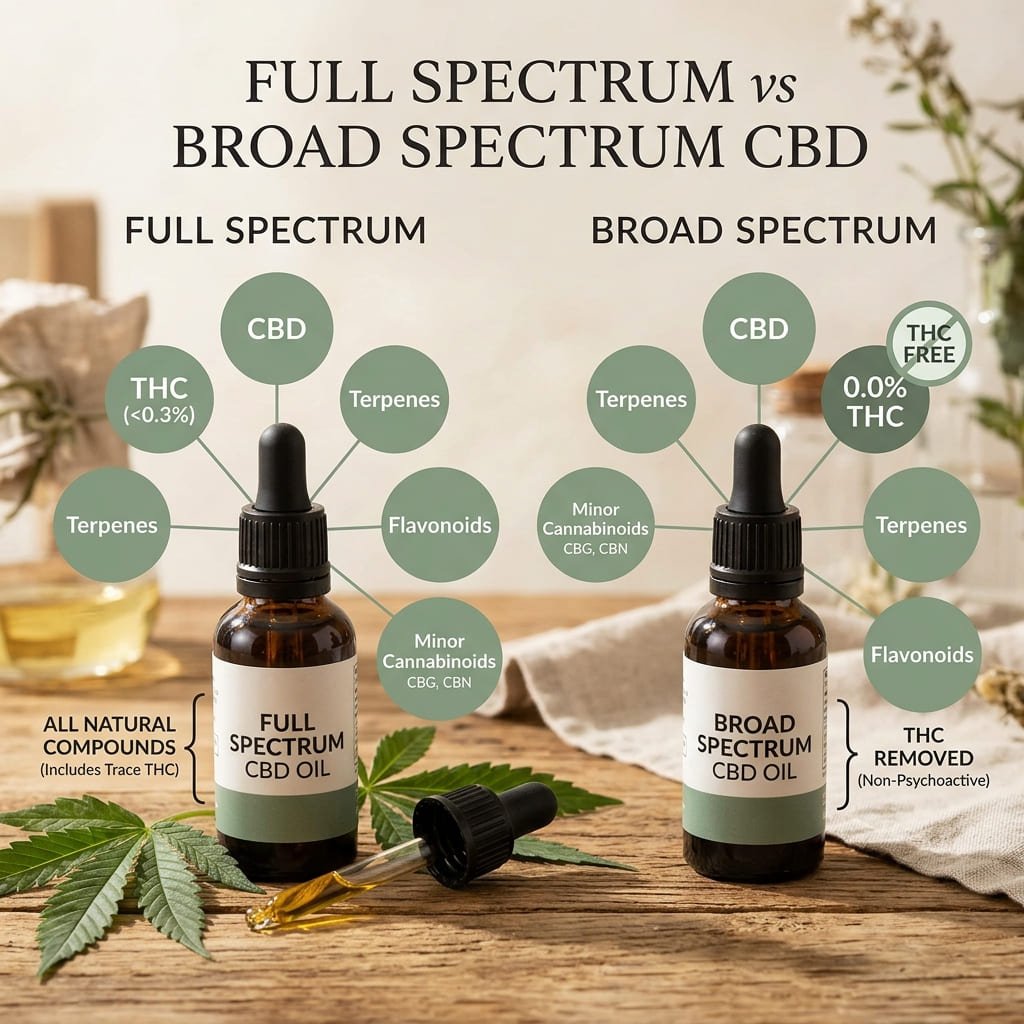
Full spectrum CBD is a whole plant extract. It keeps CBD along with the other cannabinoids, terpenes, and flavonoids found in hemp. It also includes trace amounts of THC.
In the US, hemp products have been allowed to contain up to 0.3% delta-9 THC by dry weight. That 0.3% THC limit is what separates legal hemp from marijuana under federal law. The amount is small, but it’s still there.
Full Spectrum CBD Benefits
The main draw is something called the entourage effect. This is the idea that cannabinoids and terpenes may work better together than alone. Some lab and animal studies support it, but strong human research is still limited, so treat it as a promising theory rather than a proven fact.
People often look for full spectrum CBD for sleep, since some terpenes and the small bit of THC may add to a relaxed feeling. Others try full spectrum CBD for pain, hoping the mix of compounds helps more than CBD alone. Results vary from person to person.
Can Full Spectrum CBD Get You High?
In most cases, no. The THC level in a legal product is usually too low to cause a high at normal serving sizes. That said, taking a very large amount could add up, and people who are sensitive to THC may notice mild effects. Poorly made products can also contain more THC than the label says.
What Is Broad Spectrum CBD?
Broad spectrum CBD starts out like full spectrum, but goes through an extra step to remove the THC. The goal is to keep the other cannabinoids, terpenes, and flavonoids while bringing THC down to non-detectable levels.
Think of it as a middle ground. You still get many plant compounds, which means some of the entourage effect may remain, but without the THC.
Broad Spectrum CBD Benefits
The biggest plus is peace of mind. If you want THC-free CBD but don’t want to give up the other plant compounds, broad spectrum is a good fit. It’s often a smart choice for people who want to avoid THC for personal, legal, or work reasons.
Many people choose broad spectrum CBD for anxiety because they want to stay clear-headed and avoid any chance of THC side effects. Again, research on CBD and anxiety is still young, and it’s not a replacement for medical care.
Broad Spectrum vs Isolate
Both are THC-free, so what’s the difference? Isolate is just CBD, about 99% pure, with nothing else from the plant. Broad spectrum keeps the extra compounds. If you want the possible teamwork of those compounds, broad spectrum makes more sense. If you want only CBD and the lowest chance of THC exposure, isolate wins.
Full Spectrum vs Broad Spectrum CBD: Side-by-Side Comparison
Here’s how all three types stack up on the points that matter most:
| Feature | Full Spectrum | Broad Spectrum | CBD Isolate |
| CBD | Yes | Yes | Yes (about 99% pure) |
| THC | Trace amounts | Removed (non-detectable) | None |
| Other cannabinoids (CBG, CBN) | Yes | Yes | No |
| Terpenes and flavonoids | Yes | Usually, some may be lost | No |
| Entourage effect | Full | Partial | None |
| Drug test risk | Highest | Low, not zero | Lowest |
| Taste | Earthy, strong | Milder | Almost none |
| Good for | People who want the whole plant | People who want to avoid THC | People who want plain CBD only |
Looking at CBD isolate vs full spectrum, the gap is the widest. One is a single compound, while the other is the whole plant profile.
- How Each Type Is Made
The way a product is made shapes what ends up in the bottle. There are several CBD extraction methods, including ethanol and solvent-based extraction. CO2 extraction CBD is one of the most common methods in quality products. It uses pressurized carbon dioxide to pull compounds from the plant without leaving harsh chemicals behind.
After extraction, full spectrum oil is mostly ready to use. Broad spectrum goes through extra steps, such as chromatography, to strip out THC. Isolate is refined even further until only CBD crystals are left. Some terpenes can be lost along the way, which is why broad spectrum sometimes has a milder smell and taste.
CBD and Drug Testing: What You Need to Know
This is often the deciding factor. So, does full spectrum CBD show on a drug test? It can. Most drug tests look for THC, not CBD. Even trace amounts can build up in your body with daily use and may lead to a positive result.
Broad spectrum carries a much lower risk, but not zero, since “non-detectable” depends on the lab’s testing limits. Isolate has the lowest risk. If your job depends on passing a test, talk to your employer or doctor before using any CBD.
Are Full Spectrum CBD Products Legal?
Under the 2018 Farm Bill, full spectrum products within the 0.3% limit have been federally legal in the US. But the rules are changing. A federal spending bill passed in November 2025 limits hemp products to under 0.4 mg of total THC per container, starting November 13, 2026 (source). Many full spectrum products contain more than that, so they may become much harder to find. Broad spectrum and isolate products are more likely to stay on shelves.
State laws vary too, and rules outside the US are different again. Check your local laws before you buy.
Possible Side Effects of Full Spectrum CBD
For most adults, CBD is generally well tolerated. Side effects of full spectrum CBD are usually mild and similar to other types:
- Feeling sleepy or tired
- Dry mouth
- Upset stomach or changes in appetite
- Mild THC effects in sensitive people
CBD can also interact with some medicines, like blood thinners, because it affects how the liver processes drugs. If you take prescription medicine, are pregnant, or are breastfeeding, check with your doctor first.
Which CBD Type Is Best for You?
There’s no single right answer. The best choice depends on your goals and your situation. This quick guide can help:
| If this sounds like you… | Consider this type |
| You want the most complete hemp extract | Full spectrum |
| You get drug tested at work | Isolate (or broad spectrum, with caution) |
| You want plant compounds but no THC | Broad spectrum |
| You are brand new to CBD | Broad spectrum or isolate |
| You are sensitive to THC | Broad spectrum or isolate |
| You dislike the taste of hemp | Isolate |
CBD for beginners usually works best with a THC-free option at a low strength. You can always move to full spectrum later if you want to.
The same choice applies to edibles. When comparing CBD gummies full spectrum vs broad spectrum, the rules are the same as with oils. Full spectrum CBD oil and broad spectrum CBD oil just tend to act faster than gummies, since you take them under the tongue.
How to Choose a CBD Product You Can Trust
Knowing the type is only half the job. You also need to know the product is what it claims to be. Here’s how to choose a CBD product with confidence:
- Only buy third-party lab tested CBD. An independent lab should check every batch.
- Ask for the certificate of analysis. A CBD brand worth trusting will share its COA. It shows the real cannabinoid content, THC level, and whether the product is free of pesticides, heavy metals, and mold.
- Practice reading CBD labels. Look for the extract type, the total CBD in the bottle, and the amount per serving.
- Check CBD potency. Compare the milligrams per serving, not just the bottle size. A big bottle with low potency is not a better deal.
- Avoid health promises. Brands that claim CBD cures disease aren’t following the rules.
How CBD Works in the Body
All three types interact with the endocannabinoid system, a network of receptors that helps regulate mood, sleep, appetite, and pain signals. CBD doesn’t bind to these receptors the way THC does. Instead, it seems to influence the system indirectly. The extra compounds in full and broad spectrum products may affect this system in their own ways too, which is the basis of the entourage effect theory.
The Bottom Line
Full spectrum and broad spectrum CBD are different mainly because of THC. Full spectrum keeps a small amount, along with the full range of plant compounds. Broad spectrum removes the THC but keeps most of everything else. Isolate strips it all down to pure CBD.
If you want the whole plant and THC isn’t a concern, full spectrum may suit you. If you want to avoid THC but still get other plant compounds, broad spectrum is a solid pick. Whichever you choose, start low, buy tested products, and talk to your doctor if you have any health concerns.